


Robert Currie: AI – We’re in the second quarter
Rob Currie’s keynote at the Allied Solutions Client Networking Conference (CNC 2026), Québec City
In August, credit union leaders met at the Fairmont Le Château Frontenac in Québec City for CNC 2026. One of the keynotes came from our own Rob Currie, AI Architect at Loquat Inc. Rob works in two places that rarely share a stage: financial technology and a genomics institute.
Rob’s argument is that these are the same place. In both, AI is moving out of the demo stage and into real work. In both, the hard part is governance, not the technology itself. He starts with a one-time gene-editing treatment that permanently lowers cholesterol. From there he moves to the surge of one-person businesses now becoming credit union members, the legacy core systems nobody dares to touch, and a web where bots already outnumber people. He ends with what AI doesn’t change: people still need capital, trust, accountability and someone who actually knows them. In a world where anything can be faked, he argues, that makes the community institution more valuable, not less.
If you lead a financial institution, credit union or bank, or you just want a clear, hype-free view of where AI really stands, this is worth your thirty minutes. The full text of his remarks follows, in Rob’s own words.
---------------------------------------------------------
Hello. My name is Rob Currie. I spend my time in two places that look nothing alike: financial technology, and a genomics institute. For the next thirty minutes I am going to argue that they are the same place.
PART ONE: Where this is actually happeningI want to start somewhere that has nothing to do with banking.
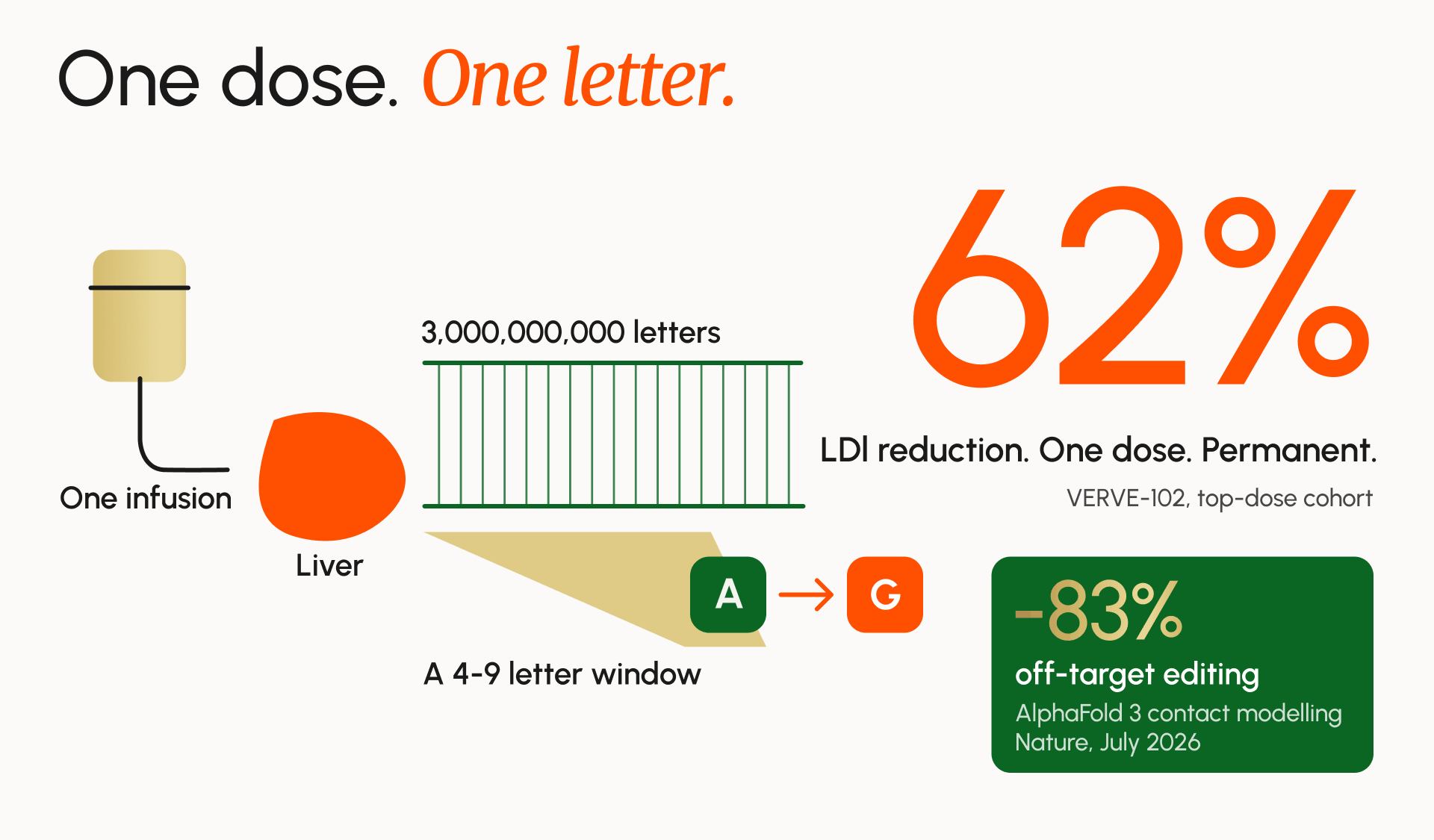
There is a gene called PCSK9. If yours is overactive, your cholesterol runs high your whole life, and you take a pill every day forever. This year participants in a clinical trial received a single intravenous infusion that traveled to their liver and changed one letter of their DNA — one A to one G — and switched that gene off. Permanently. The top-dose group averaged a 62% reduction in LDL cholesterol. One dose. Not for a month. For good. Imagine the impact on humanity and GDP if cardiovascular disease stemming from high cholesterol disappears from the next generation.
Here is why I am telling a room of credit union executives about cholesterol. The hard part of that technology was never the cutting. It was the aiming. There are three billion letters in the human genome, and the CRISPR editor works inside a window four to nine letters wide. Get it wrong and you have caused a problem worse than the one you fixed.
So how did they aim it? AI. Models trained on enormous datasets predicted which letters the editor would actually change for any given guide. Other models screened thousands of candidate guides against the whole genome, looking for anything that even slightly resembled the target. More models confirmed the sequence was identical in macaques and in humans, building trust in the results from animal studies. Nobody markets this as an AI-designed drug. But computational models did the aiming.
And three weeks ago a team fed off-target DNA sequences to AlphaFold 3 — the descendant of the protein-folding system that won the Nobel Prize last year — and assessed something much subtler: the probability that any two pieces of DNA come into contact. They used that to redesign the editor, changed two letters, and cut off-target effects by another eighty-three percent.
So: the treatment is already in humans. The AI that makes the next generation of it safer published this month. That is the clock speed. Everything I am going to tell you about your business for the next thirty minutes comes from the same technology, moving at the same speed.
The big challenge in life sciences now is how we accelerate discovery across the board — which means applying AI to how the experiments themselves are run. A startup where I am a scientific advisor has developed a system to incubate human neurons at factory scale, controlled by AI, so we can scale up the search for the causes of neurodevelopmental diseases such as autism and schizophrenia.
With a system like this an AI can read the literature, form a hypothesis, design the experiment, analyze the data, interpret the result, and draft the paper. Meanwhile robotics and cloud-connected labs are turning the physical bench into something you can address with software.
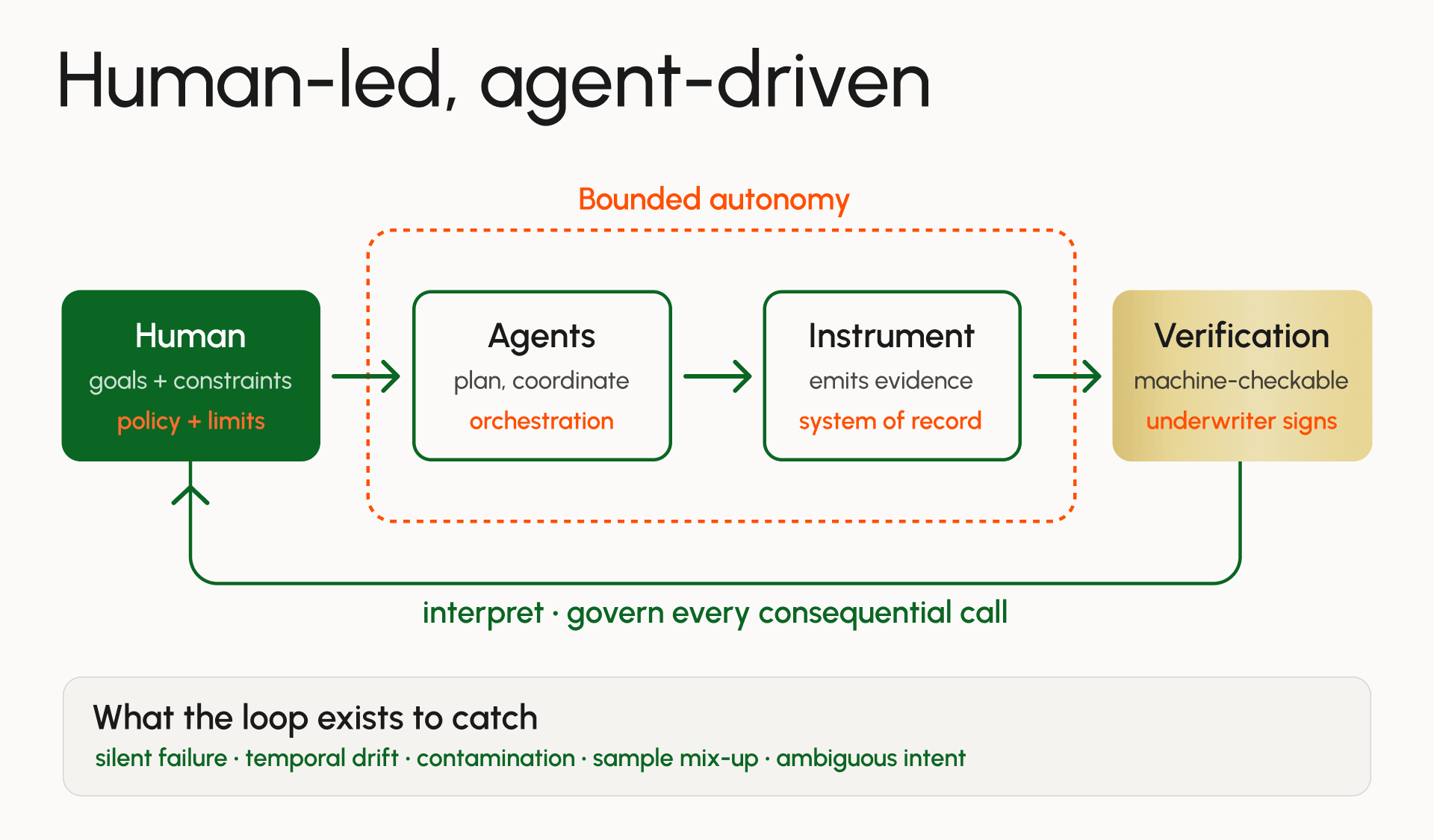
But biology has a reality gap. Experiments fail silently. A reagent degrades. A plate gets contaminated. Samples get swapped. Any one of those invalidates a perfectly sound experimental plan — and the output still looks like data. It still looks like an answer.
There are two things people constantly conflate. Automation is scripted: it repeats exactly what you told it, and it fails exactly as hard as your instructions were wrong. Autonomy is flexible: it adapts inside boundaries you set. The second one is what is actually arriving, and it only works if it is built verifiability-first.
I am showing you this not because you need to understand biology, but because biology is tackling the exact governance problem credit unions face today: how to let probabilistic models explore while human guardrails ensure zero silent failures.
From a paper called Agentic Laboratories of the Future: the most plausible next stage is human-in-the-lead systems in which agents increasingly handle integration, monitoring, workflow execution and iterative planning, while scientists remain responsible for framing objectives, interpreting anomalies, setting constraints, and governing risk.
That is not a science architecture. That is an examinable architecture. When your regulator asks how a decision was made, the honest answer is a chain of evidence, not a screenshot and a shrug. The institutions that get AI right in banking are going to arrive at this exact shape. Most of them are going to arrive at it late and expensively.
When it works, a scientist can explore combinatorially large spaces that are simply impractical to test by hand. Not faster science. Science that was previously out of reach. What this does is turn a laboratory into infrastructure that one person can address. Work that used to require an institution — a building, a staff, a budget line — is collapsing onto an individual with agents and access.
That collapse has now escaped the lab.
For those curious this is what one of those agent drive lab prototypes looks like
PART TWO: How your business members are changingAmericans filed about 5.7 million new business applications last year, and 1.56 million between November and January alone — the biggest three-month stretch on record going back to 2004. This year is running roughly twenty-five percent ahead of last. Businesses in AI-related sectors are up forty-five percent since ChatGPT launched. Construction, over the same period: ten percent.
Stripe went and asked who these people actually are, and the answer is: overwhelmingly, one person. The Census tracks which applications look likely to hire employees — those have stayed flat. All the growth is solo.
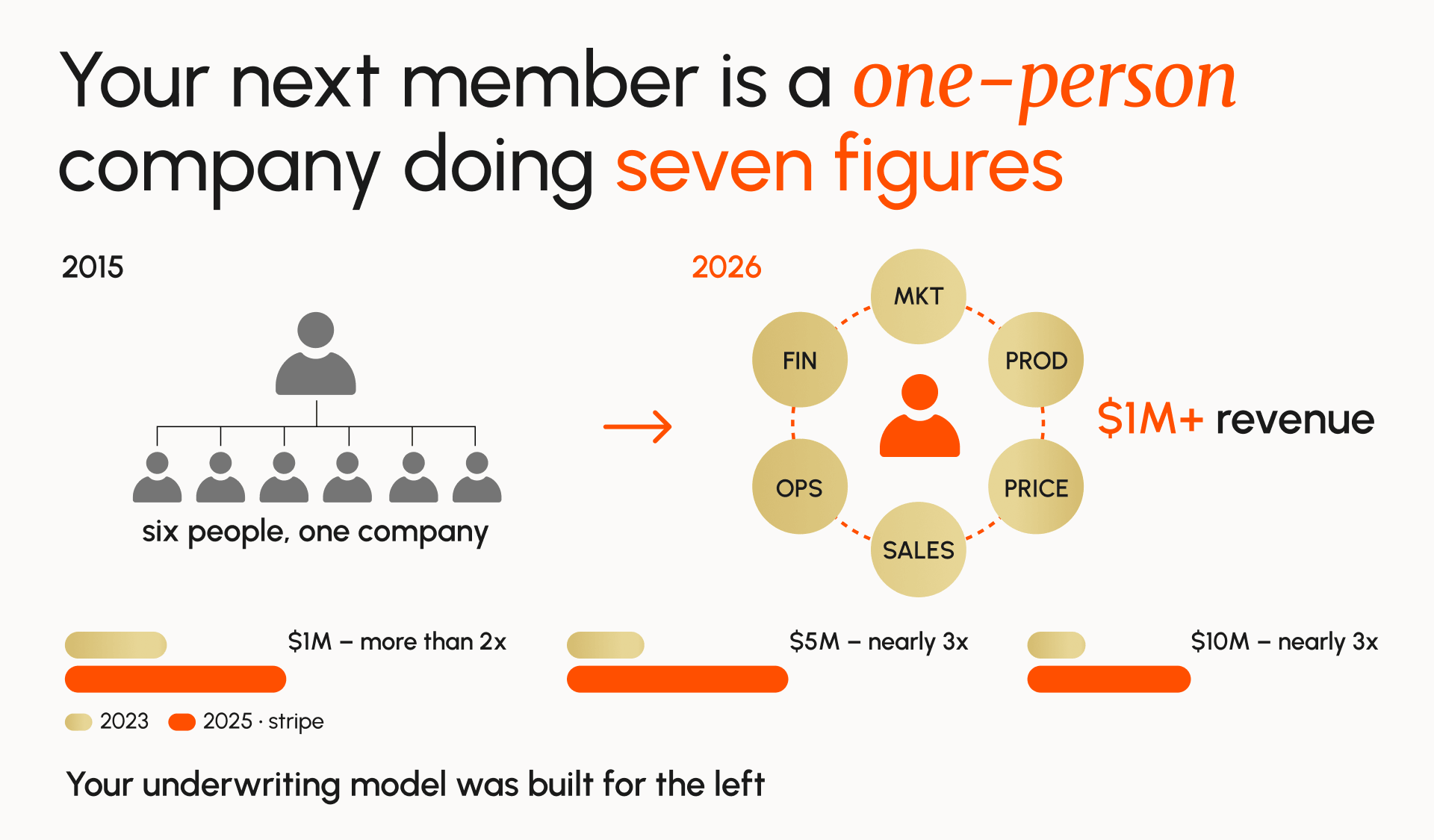
And these are not hobby businesses. More than twice as many solopreneurs cleared a million dollars in revenue in 2025 as in 2023. Close to three times as many crossed five million and ten million. Not just the count — the share doubled, which means the new cohorts are higher quality. Delaware incorporations via automated founder platforms are up about forty percent year over year. It is happening in France, Finland and Australia too, so it is not an American filing artifact.
Historically, businesses were built by groups because one person rarely has all the skills — sizing a market, building the product, pricing it, marketing it, closing the deal. AI fills the gaps a founder used to hire a human for.
And every one of them still needs capital before the revenue arrives. That part has not changed and will not change.
We have all heard this changes everything before. Web, social, mobile. We built new channels for the same work. A new front door. The back office stayed the same. This time is different, and I want to tell you why in the least hyped way I can.
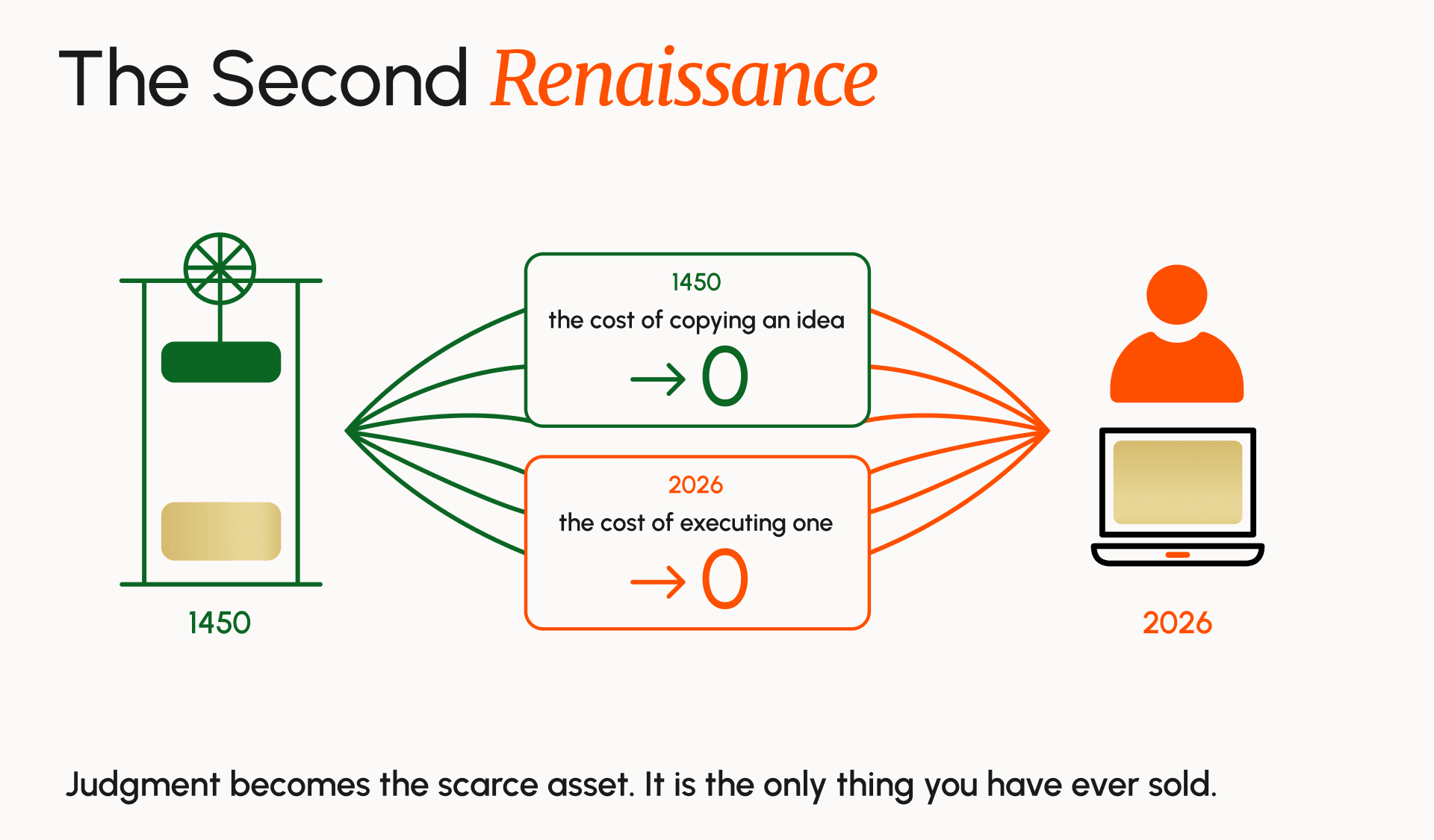
Before Gutenberg, knowledge was scarce because copying was expensive — a single book took a scribe months. Within fifty years of the printing press, twenty million books flooded Europe. And here is the thing people miss about the Renaissance: Da Vinci painted, engineered, studied anatomy, and designed machines because for the first time in history one person could pursue several domains of mastery in a single lifetime. The press did not just spread ideas. It created a new kind of person.
The printing press collapsed the cost of reproducing an idea. What is collapsing now is the cost of executing one.
A master electrician in Kentucky with no computer science degree built a load-calculation tool that sells for $12.99 and replaces a $500 service call. A plumber cancelled a forty-thousand-dollar consulting contract after one afternoon got him further than the consultants had scoped in weeks. That is not Silicon Valley. That is your members.
There is a subtler version of this too. If you work in one field and have always wanted to work in an adjacent one, you can now become what people are calling a soft expert in weeks instead of years. Not an expert — you should not claim to be — but enough to produce work a real expert will take seriously. I am doing this myself, and I hope many of you are or will as well.
Now here is the part I would push back on if I were you. Everything I just described sounds like a story about saving time. I do not think it is. A paintbrush has never saved anyone a single minute, and we have kept them within reach for tens of thousands of years. Most people are not trying to save time. They are trying to spend it. And when you watch the people who use these tools all day, they have not checked out — they are working more, and they are further into it. They stay up too late and text you at 2am to show you what they made.
So this is not a new front door. It is a new kind of worker, and a new kind of member. The web moved information around. This thing actually thinks about it.
And if execution stops being the bottleneck, the thing that decides what gets built is no longer who can raise the capital or assemble the team. It is who has judgment. Which is the only thing you have ever actually sold.
PART THREE: Inside your institutionYour core banking systems are deterministic. When someone deposits $100, the balance goes up by exactly $100. Every time. That is f(n) — a known input, a guaranteed output. And thank God for that. Nobody wants a probabilistic bank account.
But you already have AI in your organization. Your employees are probabilistic systems. Your members definitely are. Imagine if life were deterministic — you would know exactly what your spouse was going to say at dinner tonight. Predictable, sure. Also the most boring existence imaginable.
The world your members live in is messy and ambiguous too. A business owner's creditworthiness cannot be captured in a FICO score. The legitimacy of a document is not a yes/no checkbox. These are judgment calls. Your best people make good ones — but they are human. The loan assessment at 9am Monday is not the same assessment at 4pm Friday. AI does not get tired. It does not have a bad Monday. It holds uncertainty, weighs probabilities, and reasons across more variables than any team could process, with the same quality at midnight Saturday as Tuesday morning.
The magic is pairing the two: deterministic rails for the transactions that must be exact, probabilistic intelligence for the judgment calls. That is the same architecture I showed you in the lab — the instrument is exact, the reasoning around it is not, and a human governs the boundary between them.

The number one barrier to deploying new technology in your institution is not the technology. It is the integration. The six-month scoping exercise. The consultant billing $400 an hour to read your COBOL documentation. The project that was supposed to take three months and took eighteen. Seventy percent of credit unions report difficulty integrating new solutions into existing systems — higher than any other kind of institution.
And underneath that, the core itself. For decades your core banking system has been treated like nitroglycerin — do not touch it, do not breathe on it. For good reason: breaking something that processes every transaction for every member was existential. So you built middleware around it, layer upon layer, and each layer added cost, complexity and fragility.
Now imagine deploying an AI agent — under your control, inside your firewall — that reads your entire core banking codebase, maps every dependency, understands every API, compressing months of discovery into days of validated mapping.
Y2K consumed years and billions of dollars. The equivalent remediation today is measurable in prompts, not person-years.
You do not need to rip and replace your core. You need to make it accessible. This is not about being held hostage by your core vendor anymore. It is about being able to move — or to cut out twenty years of accumulated middleware.
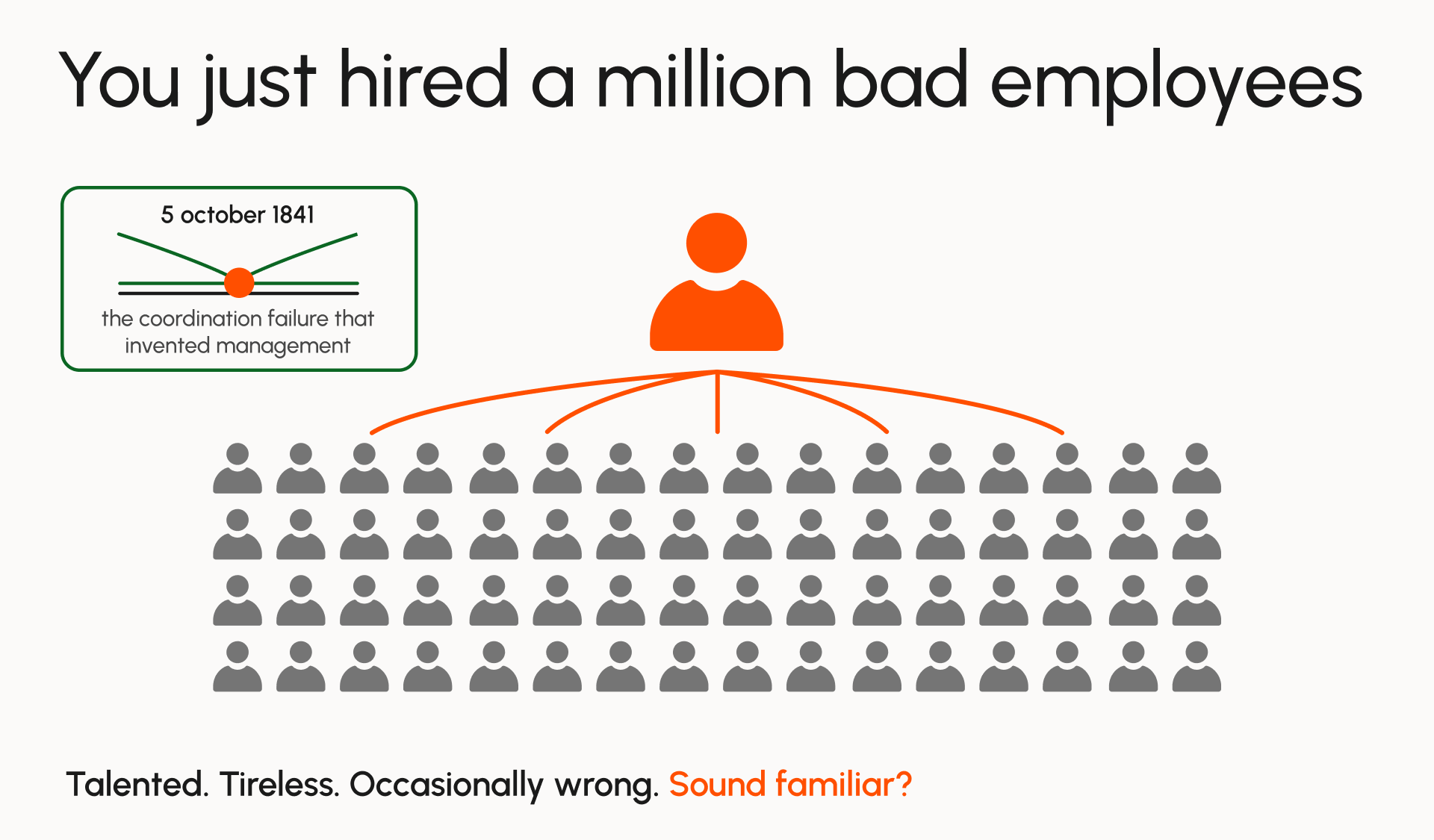
In the 1830s the railroads drove the biggest infrastructure buildout the world had ever seen. American track mileage went up 120x in a decade. Then, on October 5th, 1841, two trains collided head-on on the Western Railroad in Massachusetts. People died. The cause was not mechanical. It was a coordination failure — the system had outgrown what an individual conductor could hold in his head.
What came next is the part nobody remembers. The railroads spent the following decades inventing the thing we now call management. Regional managers. Defined roles. Hierarchies and reporting lines. Modern management was invented because a technology got too complex to run informally. And then rail became the world's first billion-dollar industry.
We just did it again. We handed every employee in every company — including the worst ones — effectively infinite headcount and infinite budget. And AI scales dysfunction instantly.
Maybe one in a hundred people knows how to give one of these systems proper context. Give the other ninety-nine an agent and they produce loops — agents calling themselves to fix themselves, because nobody ever articulated the task cleanly. That is spending tokens on spending tokens. The majority of current agent spend is still exploratory or poorly scoped. Which, if we are candid, is roughly the same claim people make about meetings.
The single best predictor of whether AI works in your institution is whether you can define what good looks like — write down, precisely, what a correct answer is. In software that is easy: the code runs or it does not. That is why coding was the first thing AI ate. Everything else is waiting for someone to write the test.
Your best people know things that are not written down anywhere. Tribal knowledge has been job security for centuries — medieval guilds kept their methods secret. This is the first technology that asks your experts to hand all of it over at once. Nobody trains their replacement for free. If you do not think about that honestly, the people holding your most valuable knowledge have every reason to withhold it, and your AI program quietly fails for reasons that have nothing to do with technology.
But look at what that adds up to. Defining good. Reviewing work. Escalation paths. A second signature on anything that matters. Understanding why a good employee might not want to share what they know. That is a management problem, and this room has spent entire careers on it. Point that discipline at this and you will be ahead of firms with ten times your technology budget.
 PART FOUR: What’s coming, and what stays
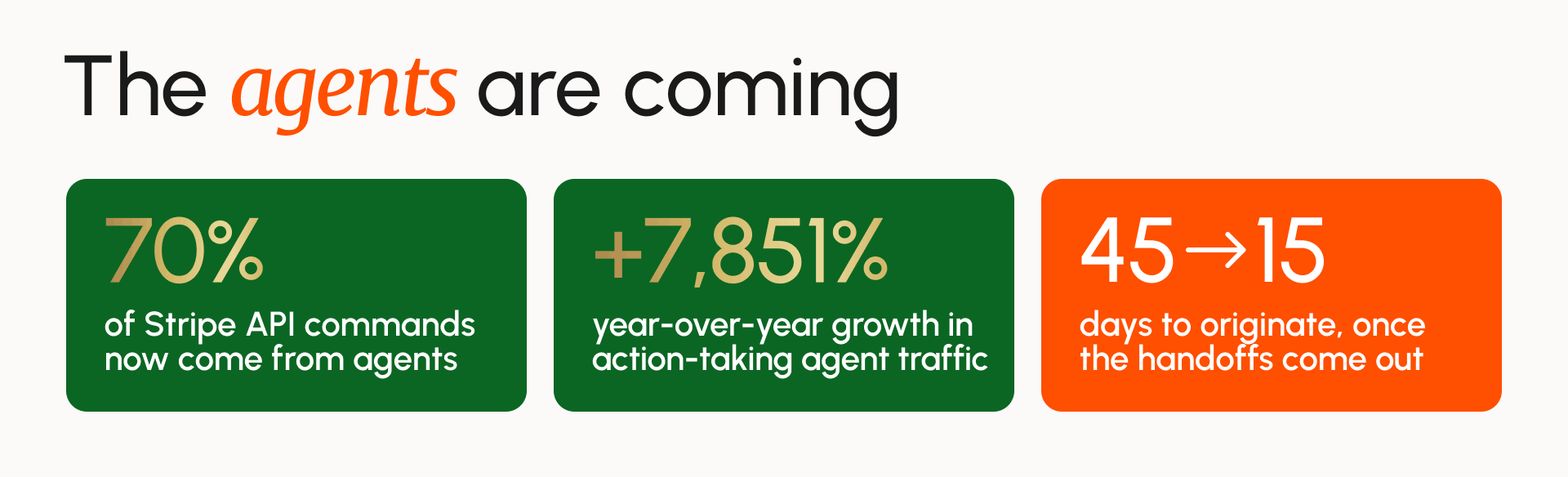
Traffic from agents that take actions — click, fill in forms, submit applications — grew over 7,000% year over year. Stripe reports that seventy percent of the commands hitting its API now come from agents. A quarter of developers design their APIs with agents as the primary consumer, not humans.
Within a few years, a large share of the interactions with your institution will not come from a person at a keyboard or walking into a branch. They will come from agents acting for your members — the business owner who told their assistant to find the best line of credit, compare rates, submit the application, and negotiate terms. The HVAC solopreneur's bookkeeping agent will negotiate an increase in working capital while they drive from the contract signing to the ducting supply depot.
Your members' personal AI is already more capable than most of the digital interfaces you offer. It can summarize a forty-page loan document in seconds, compare your rates against four competitors simultaneously, and draft a complete business plan to attach to an application. Your members are arriving at your digital front door with capabilities that exceed what is on the other side.
And this cuts both ways, because agents work on your side of the counter too. A business loan application today touches a dozen people and systems — someone collects documents, someone checks them, someone pulls credit, someone chases a missing bank statement, an underwriter reviews, compliance files. At every handoff, time leaks and errors creep in. Traditional banks average thirty to sixty days; SBA-backed loans stretch to ninety. Institutions running agents through that workflow are compressing forty-five days to under fifteen — not by making each person faster, but by removing the handoffs. And notice the shape of it: bounded autonomy, evidence at every step, a human on the final call. Same loop as the lab.
So the number of people visiting your website will plateau. The number of agents querying your services will explode. The institutions that win will not have prettier mobile apps — they will have richer APIs an agent can negotiate with, routed to human oversight only when the stakes demand it. The same AI that reads your core COBOL can build the layer that makes you agent-ready.
But — and this is the part I do not want lost — your members may still want to come into your branch. They may want to look someone in the eye when they sign for a mortgage. The agent handles the homework. The human handles the handshake.
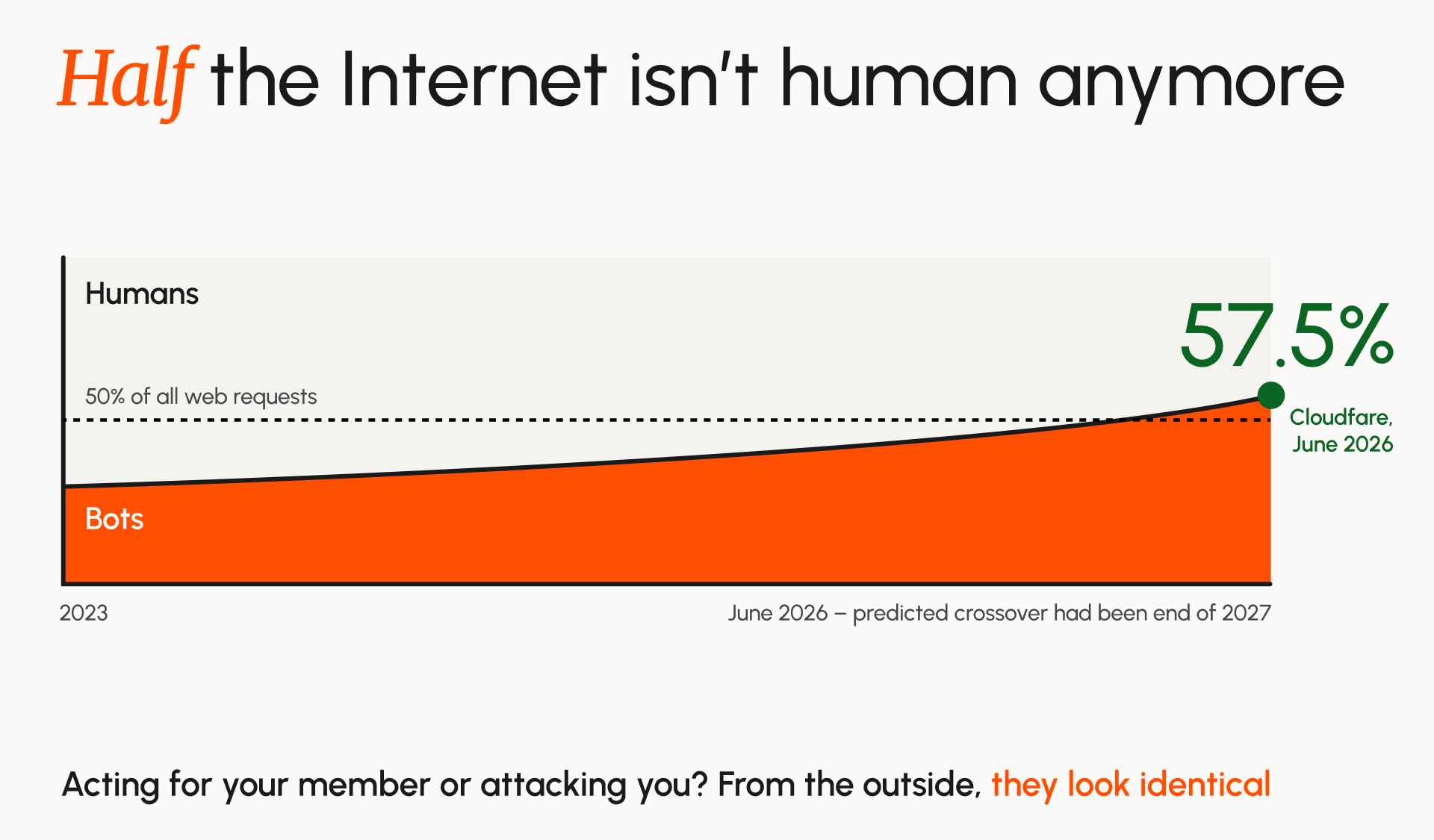
There is a theory that has floated around for years called the Dead Internet Theory — that most of what is online is not people anymore. It used to be a conspiracy theory. As of June, Cloudflare measures 57.5% of all web requests as bots. Cloudflare's own CEO predicted in March that the crossover would not happen until the end of 2027. It arrived more than a year early. And predictions are that it will be 1000x humans in five years.
Some of those agents are your members' assistants doing legitimate work. Some are attacking you. From the outside, right now, they look identical.
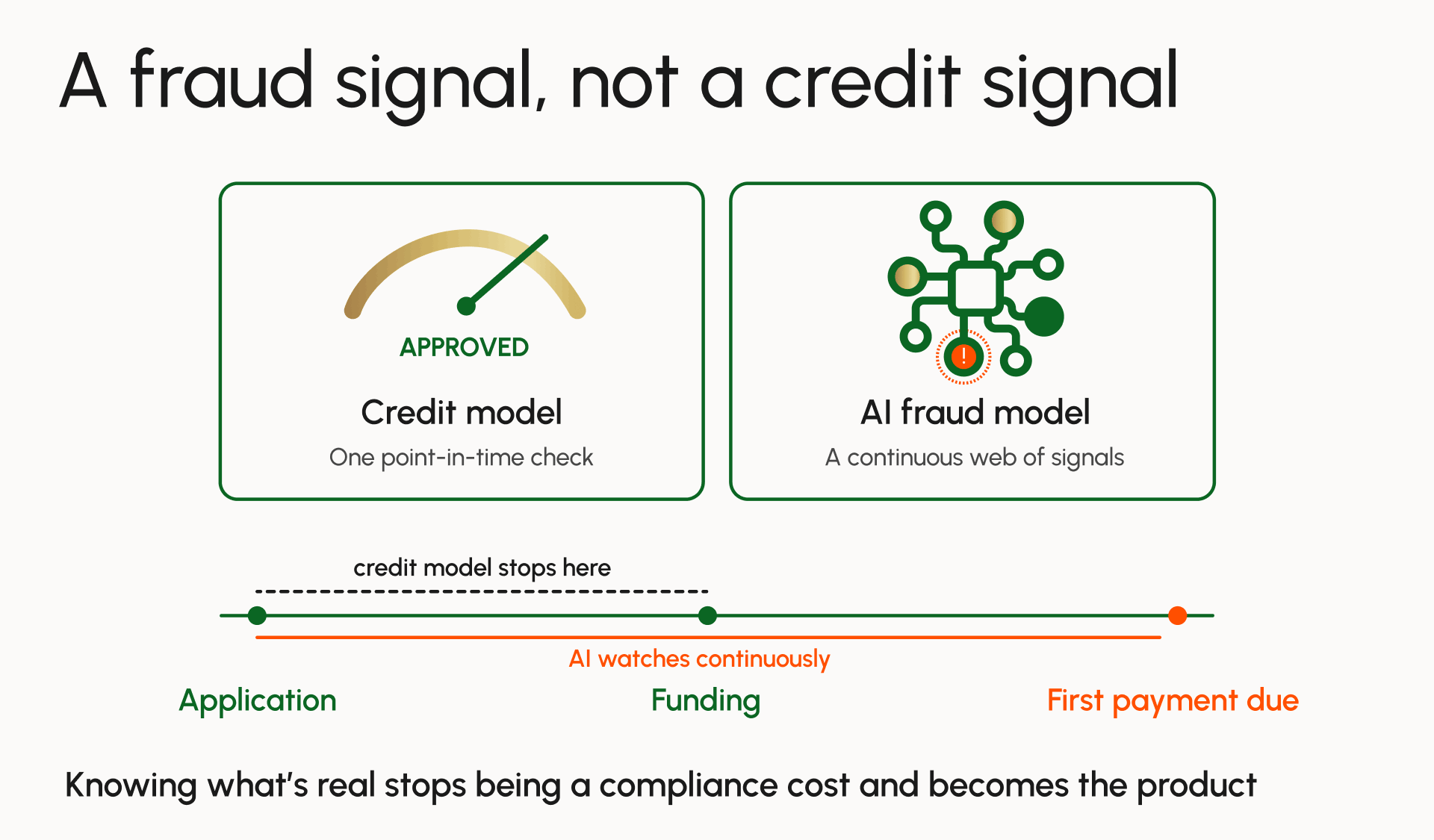
When a borrower defaults on their very first payment, the traditional response is to treat it as a credit problem — the model missed something. The data says otherwise. In a growing number of cases, first-payment default is not a credit signal at all. It is a fraud signal. The borrower never intended to repay.
Synthetic identities — a real Social Security number blended with fabricated details, an AI-generated face, a manufactured credit history — now pass traditional underwriting. They look like a reasonable risk on paper. They get approved. They take the funds. They vanish before the first payment.
Credit models are not built to catch that. They look at debt-to-income and payment history, not at whether the document metadata suggests machine generation, whether the same device submitted four applications with different identities in a week, or whether the behavior during the application matches a human or a bot.
AI flips the lens. Instead of asking can this person repay as a static, point-in-time assessment, it asks is this person real continuously — from application through funding through the first payment cycle, correlating document forensics, device fingerprinting, application velocity, behavioral biometrics, entity resolution against public records.
Your fraud loss rates are already better than the industry — around half a basis point against 0.8. But that number hides the loans that never should have been made. Catching a synthetic identity before funding does not just prevent a loss. It protects a slot in your pipeline for a real member with a real business who actually needs the capital.
In a world where most traffic is not human, being the institution that can tell what is real stops being a compliance cost and becomes the product.
AI can fabricate a face, forge a document, and generate a convincing business identity from scratch. Sixty-eight percent of you are increasing fraud-detection spending. Which is why knowing your customer and knowing your business becomes the bedrock capability in an AI-powered world. Not less important. More important. The one thing AI cannot replace is ground truth.
And I want to leave you with a different question than the one everybody is asking. Bezos used to say he got asked constantly what would change in ten years and almost never what wouldn't.
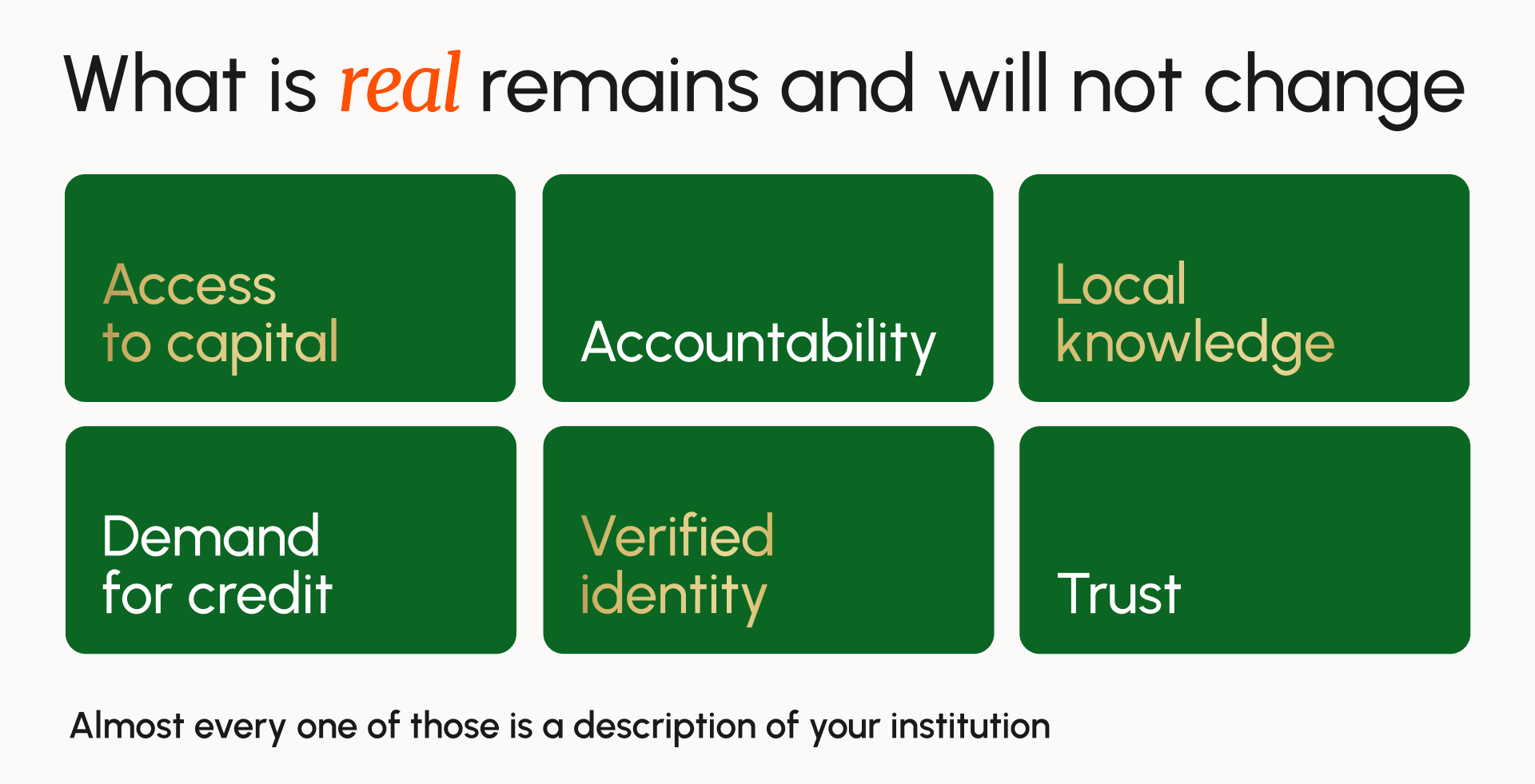
People and businesses will continue to need access to capital. Underwriting methods evolve; demand for credit is persistent. People will keep wanting accountability and recourse and a name to call when something goes wrong. Local knowledge will stay valuable and hard to replicate. Trust gets scarcer and more valuable as content, code and fraud get cheaper. Verified identity becomes more important as information becomes abundant and synthetic. Almost every one of those is a description of your institution.
Neobanks can build slick mobile apps; mega-banks have multi-billion-dollar tech budgets. But when synthetic identities flood the internet, local physical presence, member field of membership, and verified community trust are structural moats. The community institution that knows its people is not a relic — in a world where anything can be fabricated, it is the most valuable moat there is.
So let me end where I started. There is an enormous amount of noise in the AI space — but underneath it there are a handful of changes that will genuinely matter for the people you serve. AI that verifies a business identity in seconds — that matters to the business owner who needs a line of credit this week. AI that reads your legacy systems and builds a bridge — that matters to the IT team told to do more with less for the fifth year running. Agents that negotiate with your systems on a member's behalf — that matters to the single parent running a business who does not have time to fill out another PDF.
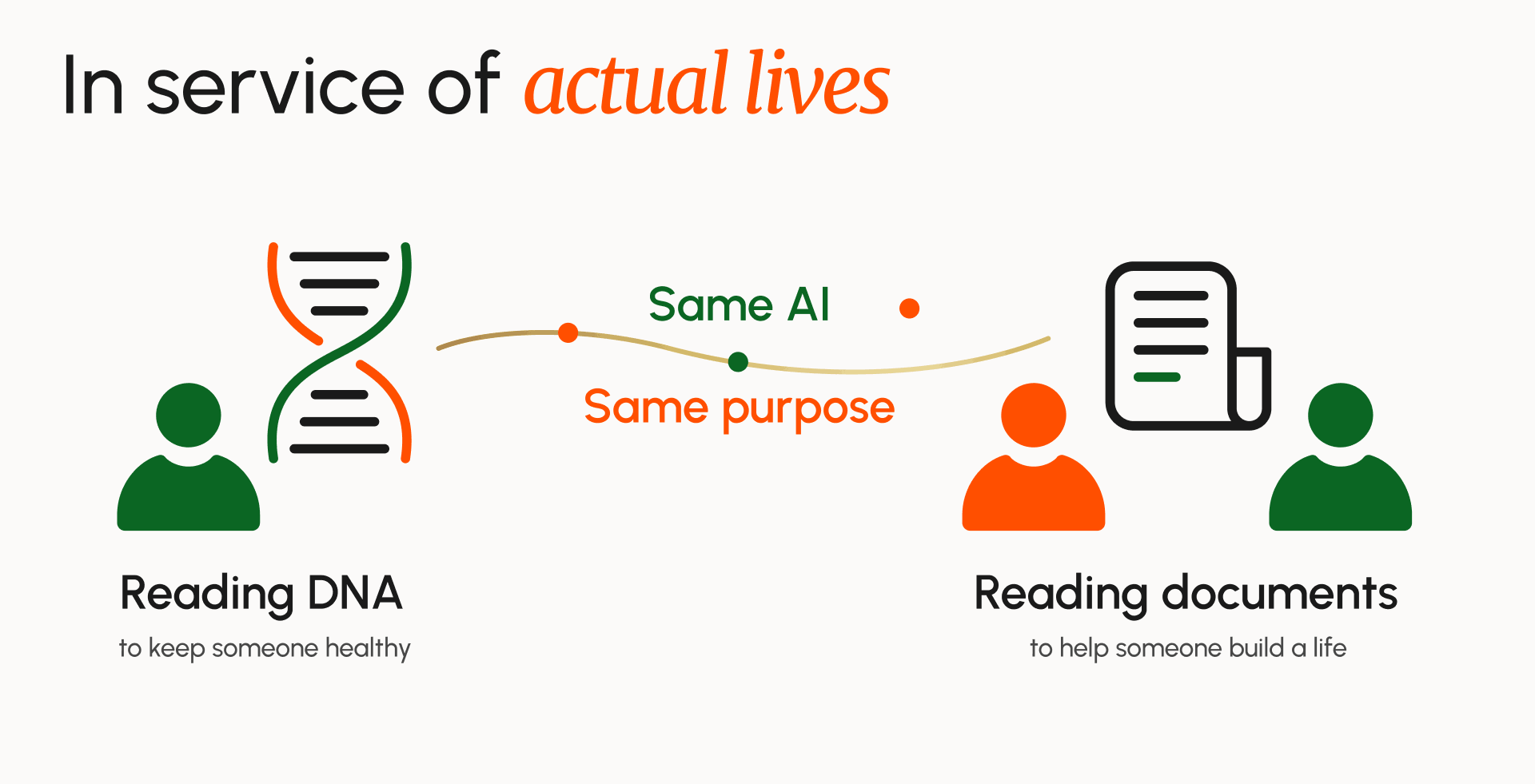
In life sciences and financial services we are ultimately doing the same thing: using the most powerful technology humans have ever built in service of actual lives. In one case it is reading DNA to keep someone healthy. In the other it is reading documents to help someone build a business and buy a home. Both are worth getting right.
You got into this because you believe financial services should serve the community, not extract from it. AI applied thoughtfully is the most powerful amplifier of that mission you will ever see.
Thank you.